

Why Is Survival Not Selfish
Is Survival Selfish?
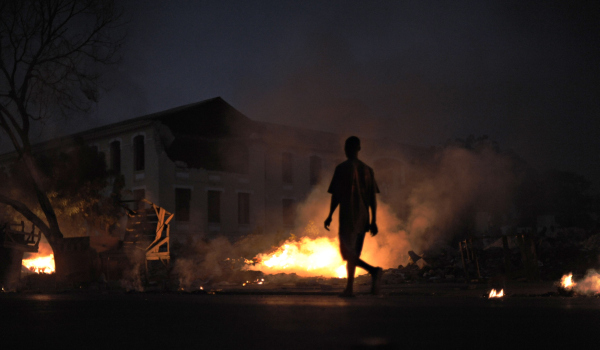
In his merely-released book The Final Train From Hiroshima, Charles Pellegrino quotes one of the survivors of the Hiroshima and Nagasaki atomic bomb blasts every bit maxim that those who survived were, in full general, those who looked after their own safety, instead of reaching out to aid others. "Those of us who stayed where we were ... who took refuge in the hills behind the hospital when the fires began to spread and close in, happened to escape alive. In short, those who survived the flop were ... in a greater or bottom degree selfish, cocky-centered--guided by instinct and not past civilization. And nosotros know it, we who have survived."
Merely is survival actually selfish and uncivilized? Or is it smart? And is going in to rescue others ever heroic? Or is information technology sometimes just stupid? Information technology'southward a circuitous question, considering there are and so many factors involved, and every survival situation is unlike.
Self-preservation is supposedly an instinct. So 1 would call back that in life-and-decease situations, nosotros'd all be very focused on whatever was necessary to survive. But that's not ever true. In July 2007, I was having a drink with a friend in M Fundamental Station when an underground steam pipe exploded just outside. From where we sat, we heard a dull "boom!" and and so suddenly, people were running, streaming out of the tunnels and out the doors.
My friend and I walked quickly and calmly outside, only to go whatsoever further, nosotros had to push our way through a crowd of people who were staring, transfixed, at the cavalcade of fume rising from the front of the station. Some people were crying, others were screaming, others were on their prison cell phones...but the crowd, for the most part, was not doing the one thing that would increase everyone's chances of survival, if in fact a terrorist bomb with god knows what inside it had but gone off--namely, moving away from the area.
Nosotros may have an instinct for survival, merely it clearly doesn't e'er kick in the way it should. A guy who provides survival training for pilots told me one time that the number i determining factor for survival is just whether people concord it together in a crisis or fall apart. And, he said, it'due south impossible to predict ahead of time who's going to hold information technology together, and who's going to fall apart.
So what is the responsibleness of those who hold it together? I remember reading the business relationship of 1 woman who was in an airliner that crashed on landing. People were frozen or screaming, only nobody was moving toward the emergency exits, fifty-fifty as fume began to fill the cabin. Afterwards realizing that the people around her were likewise paralyzed to react, she took straight action, crawling over several rows of people to get to the exit. She got out of the plane and survived. Very few others in the plane, which was shortly consumed by smoke and fire, did. And afterward, I call back she said she battled a lot of guilt for saving herself instead of trying to save the others.
Could she really accept saved the others? Probably not, and certainly non from the back of the plane. Just similar the Hiroshima survivors, if she'd tried, she probably would have perished with them. And so why do survivors berate themselves for non calculation to the loss past attempting the impossible? Perhaps it'southward because we get very mixed messages about survival ethics.
On the one paw, we're told to put our ain oxygen masks on first, and not to jump in the water with a drowning victim. But then the people who ignore those edicts and survive to tell the tale are lauded as heroes. And people who do the "smart" thing are sometimes criticized quite heavily after the fact.
In a famous mount-climbing accident chronicled in the book and documentary Touching the Void, climber Simon Yates was attempting to rope his already-injured friend Joe Simpson down a mountain in bad weather when the belay went awry. Simpson concluded upwards hanging off a cliff, unable to climb upwardly, and Yates, unable to lift him up and losing his own grip on the mountain, ended up cutting the rope to Simpson to save himself. Miraculously, Simpson survived the 100 foot fall and eventually fabricated his style down the mount. But Yates was criticized by some for his survival decision, fifty-fifty though the alternative would take near certainly led to both of their deaths.
In Yates' case, he had time to think hard most the odds, and the possibilities he was facing, and to realize that he couldn't save anyone only himself. But what well-nigh people who have to brand more instantaneous decisions? If, in fact, survivors are driven by "instinct non civilisation," as the Hiroshima survivor put it, how do you explain all those who cull otherwise? Who would dive into icy waters or onto subway tracks or disobey orders to make repeat trips onto a minefield to bring wounded to rubber? Are they more civilized than the rest of united states of america? More brave? More noble?
It sounds nice, but oddly plenty, near of the people who perform such impulsive rescues say that they didn't really recollect before acting. Which means they weren't "choosing" civilization over instinct. If survival is an instinct, information technology seems to me that in that location must be something equally instinctive that drives us, sometimes, to run into danger instead of away from it.
Peradventure it comes down to the ancient "fight or flying" impulse. Animals confronted with danger will cull to attack information technology, or run from it, and information technology'south hard to say which one they'll choose, or when. Or maybe humans are such social herd animals, dependent on the herd for survival, that we feel a pull toward others even as nosotros feel a contrary pull toward our ain preservation, and the 2 impulses boxing it out within u.s.a. ... leading to the mixed messages nosotros transport each other on which impulse to follow.
Some people hold it together in a crisis and some people fall apart. Some people might run abroad from danger 1 solar day, and toward it the next. We pick up a yard cues in an instant of crisis and respond in means that even surprise ourselves, sometimes.
But while we laud those who sacrifice themselves in an effort to save another, there is a fine line between brave and foolish. At that place can likewise exist a fine line betwixt smart and selfish. And every bit a friend who'southward served in the military machine for 27 years says, the truth is, sometimes at that place'due south no line at all betwixt the two.
Photo credit: Roberto Schmidt/AFP-Getty

Why Is Survival Not Selfish,
Source: https://www.theatlantic.com/national/archive/2010/01/is-survival-selfish/34962/
Posted by: mooremushmers.blogspot.com
0 Response to "Why Is Survival Not Selfish"
Post a Comment